In the third session of the One Health Policy Seminar, held on Thursday, November 5, 2026, Prof. Flaminia Aperio Bella provided an in-depth examination of the One Health approach in Italian legislation, focusing on sources of soft and hard law .
Part 1 of the Lecture – Soft and Hard Law Sources (LAWS AND REGULATIONS) mentioning OH/PH.
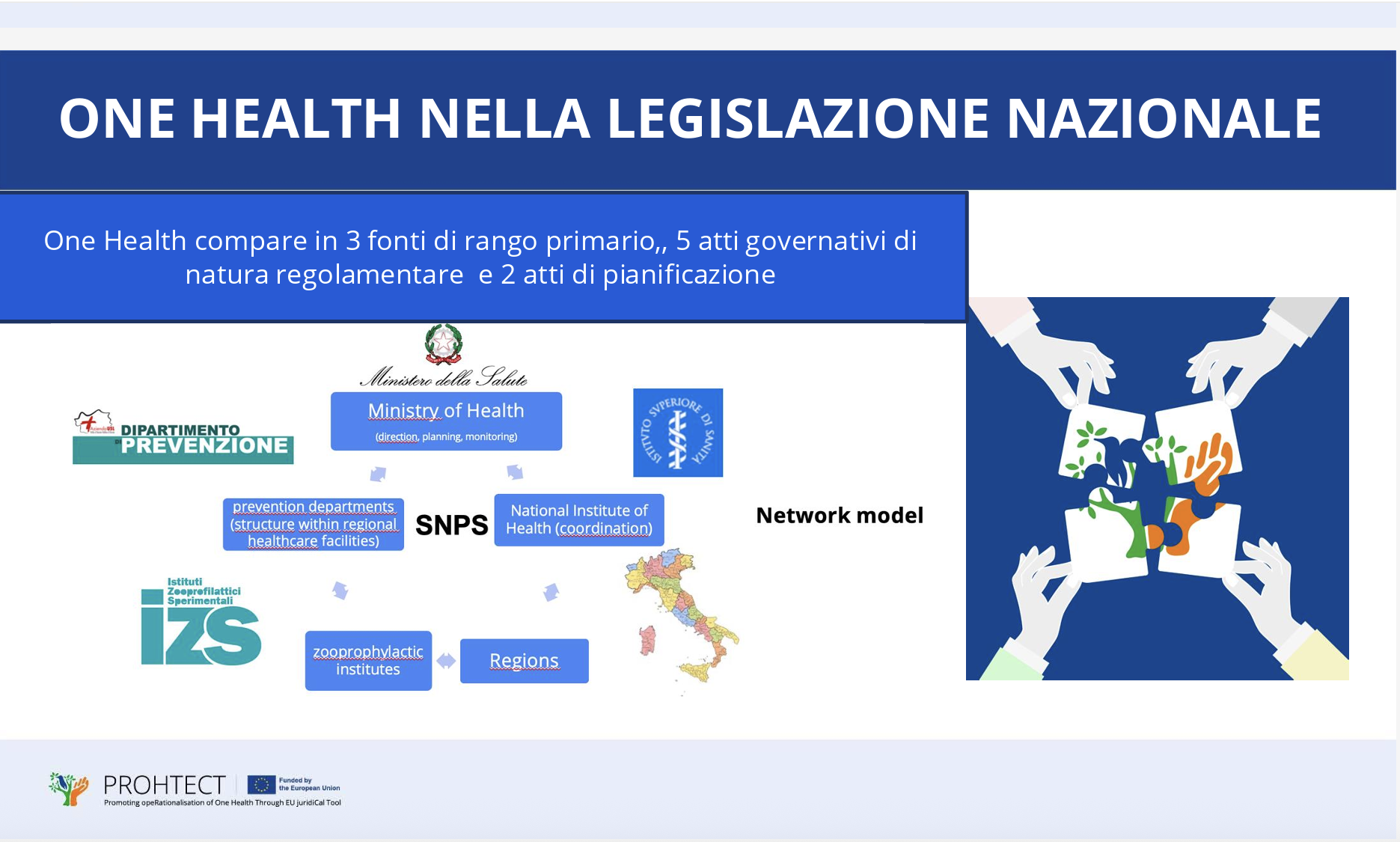
In the Italian legal system, references to One Health (OH) appear in sources of soft and hard law.
- The National Prevention Plan (2020–2025) adopts the OH approach and emphasizes its qualitative aspects;
- The National Plan to Combat Antimicrobial Resistance (AMR, 2022–2025) defines the OH and implements it methodologically.
- The Ministerial Decree No. 77/2022, implementing Mission 6 “Health” of the PNRR, establishes an integrated model for local healthcare that establishes national standards which all regions must comply with.
- Article 27 of Decree-Law No. 36/2022 establishes the National System for Health Protection against Environmental and Climate Risks (SNPS), based on the OH approach as it has evolved into Planetary Health (PH).
- Prime Ministerial Decree No. 196/2023 subsequently reorganized the Ministry of Health, creating a Department dedicated to human, animal, and ecosystem health (One Health as a conceptual framework).
However, the One Health approach is often invoked but not always implemented: the composition of the SNPS, for example, does not fully reflect it. The question of whether to keep One Health and Planetary Health—which increasingly overlap—separate or to unify them into a comprehensive approach also remains open. In any case, the priority is to build synergies and collaborate.
Part Two of the Lecture – Prevention Pays Off: The Reasons for OH and the Determinants of Health
While the sources examined indicate that the One Health approach is referenced but not always implemented, the reasons for putting it into practice remain to be clarified: they are of an economic, constitutional, and scientific nature.
- On the economic front, a report by the Istituto Superiore di Sanità (ISS)—a public agency dedicated to research and professional development—has focused on OH initiatives, calling for an assessment of their cost-effectiveness: responding to an emergency caused by a natural disaster costs far more than preventing it through an OH approach.
- At the constitutional level, Article 41 of the Constitution requires that environmental protection be integrated into economic activity, and the National Plan to Combat Antimicrobial Resistance was created precisely to strengthen the OH.
- On the scientific front, the relationship between health and the environment has also broadened: from Environmental Health, which studies the pathogenic effects of chemical, physical, and biological agents, the focus has shifted to Multiple Determinants of Health, that is, the multiple determinants of health: social, economic, environmental, and cultural conditions, as well as living and working conditions and individual behaviors.
This results in a transdisciplinary approach that, on the one hand, makes professionals in various sectors aware of the interconnection between issues such as climate change and agricultural policies and, on the other hand, educates the next generation so that future decision-makers can tackle problems with all the necessary skills, considering them from every angle from the very beginning.